


Scrap buyers, Delhi NCR
Key points
- The handback date, not the scrap value, drives every decision in a strip-out.
- Read the dilapidation clause before you plan anything — it defines what "clear" means contractually.
- Building management approvals routinely take longer than the work itself. Start them first.
- On a fitted floor the material buy-back frequently covers most of the removal cost.
Office strip-outs go wrong for one reason far more than any other: someone treats them as a clearance job rather than a project with a contractual deadline. The lease ends on a date, the dilapidation clause specifies a condition, and if the floor is not in that condition the landlord's remedy is expensive.
This is the sequence we walk through with facility and admin teams. It assumes roughly six weeks. If you have less, the same order applies but everything compresses and crew size goes up.
Start with the lease, not the furniture
Find the dilapidation or reinstatement clause and read it carefully. It will say one of three things: hand back as-is, hand back in the condition received, or hand back to base build. These are wildly different scopes. "Condition received" on a floor you took bare means removing everything you installed — partitions, ceiling, flooring, cabling, the lot.
Then check what the fit-out drawings say you actually installed, because after three tenants nobody remembers which partitions came with the floor. If drawings do not exist, the handover photographs from when you moved in usually settle it.
Six weeks out
- Book the survey. Get the removal contractor to walk the floor with you. They should quote a cost and a buy-back value as two separate figures.
- Notify building management. Ask for their fit-out and strip-out rules in writing: permitted working hours, service lift booking, insurance levels required, whether hot work is allowed at all.
- Start the IT inventory. Every asset tag, and crucially every device that has ever held data. This takes longer than anyone expects.
- Decide what is being reused. Furniture moving to the new office should be identified and tagged now, not on the day.
Three weeks out
- Submit the method statement and insurance to building management. Approvals are the single most common cause of a strip-out starting late.
- Book the service lift. In a busy building these go weeks ahead, and without one nothing leaves the floor.
- Arrange isolations. Electrical isolation, HVAC shutdown and fire system isolation each need a named person and a certificate.
- Confirm the disposal route. E-waste to an authorised recycler; batteries through the battery channel; used refrigerant recovered, not vented. Ask for the documentation you will receive.
The week of
- Floor cleared of personal effects and anything being retained — the contractor should not be deciding what is rubbish.
- Server room last, so the network stays live as long as possible.
- Photograph the floor before work starts. It is the only evidence of pre-existing damage you will have.
- Someone from your side on site each day. Not full time, but present.
IT and data — the part that carries real risk
Scrap value on IT hardware is a rounding error next to the cost of a data incident. Every device that has held data — desktops, laptops, servers, network gear, multifunction printers with internal drives, even some access control panels — needs either a certified wipe or physical destruction.
Insist on a certificate listing serial numbers. If the environment is sensitive, have the destruction done on your floor before anything leaves the building; that removes the chain-of-custody question entirely. Under India's E-Waste (Management) Rules your obligation as the waste generator does not end when the truck leaves, so keep the handover record naming the authorised recycler.
What the buy-back actually covers
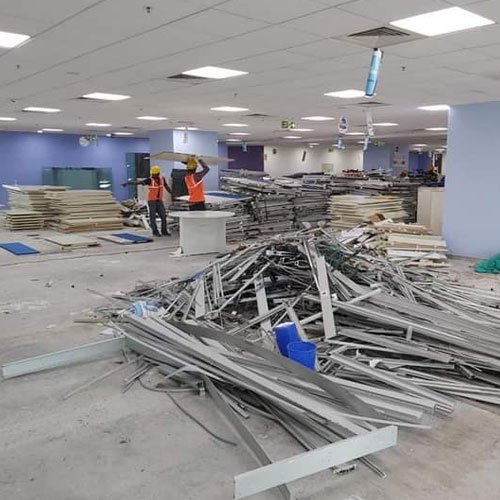
On a typical fitted floor — modular workstations, metal partitioning, ducting, cable trays, light fittings, structured cabling and IT hardware — the recovered material value frequently covers most of the strip-out cost, and on metal-heavy floors it can exceed it.
On a lightly fitted floor with mostly gypsum partitioning, carpet and few fixtures, it will not. Both are normal outcomes. What matters is that the contractor shows you the cost and the buy-back as separate numbers, so you can see which one you are in rather than being handed a single figure with the arithmetic hidden inside it.
Questions
How long does an office strip-out take?
For a typical 5,000–10,000 sq ft fitted floor, three to six working days with an adequate crew, plus mobilisation. The constraint is rarely the work — it is building permissions, service lift access and permitted working hours, which is why those get started first.
Can strip-out work happen at night or on weekends?
In most commercial buildings it has to. Managements restrict noisy work and service-lift use during business hours to protect other tenants. Any contractor who has worked in managed buildings will quote out-of-hours work as standard rather than as a premium.
Who is responsible if the floor is damaged during removal?
The contractor, which is why public liability insurance is not optional and why you photograph the floor before work starts. Ask for the certificate before mobilisation, not after an incident.
What happens to the furniture we do not want to scrap?
Modular workstations and chairs in good condition have resale value and a reasonable contractor will tell you when scrapping something is the wrong answer. Charitable donation is also worth asking about — schools and NGOs often take usable office furniture.